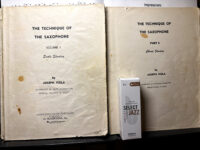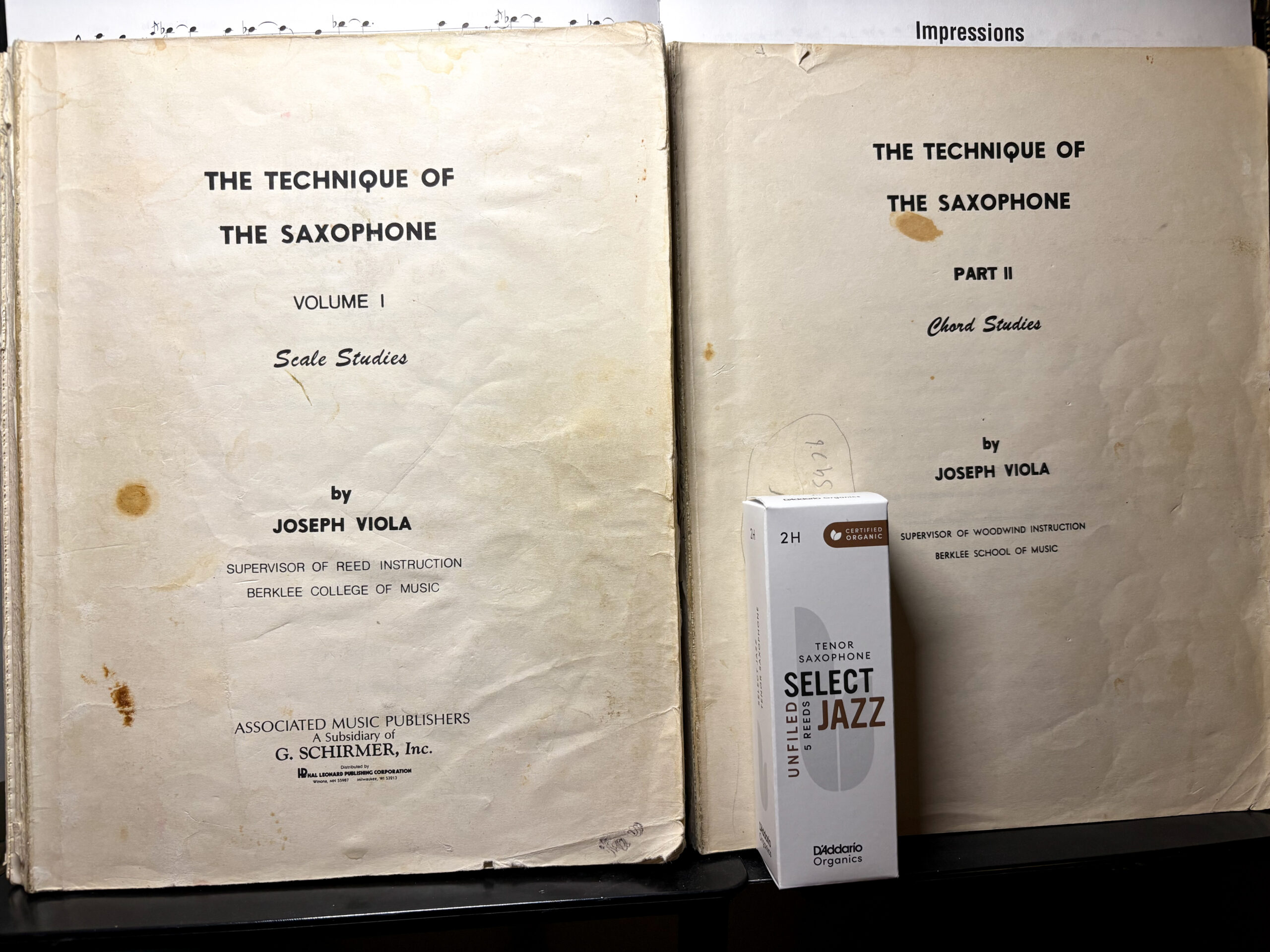
My cherished original Joe Viola books from high school. I love that I still have them, although I have to get newer copies and put these in plastic sleeves to preserve them because the glue on the bindings is starting to fail.
I posted a picture a while ago on my Instagram/Facebook story and I was surprised how many people messaged me about it. The people reaching out were not limited to saxophone players either.
There were two basic lines of questions. The first and most obvious one was “What books are those?”. The second line of questioning was asked by people that already knew what the books were, and I found that train of thought much more interesting.
That basic line of questioning was centered around “Those books are pretty simple, or aren’t really complex..so why do you still work from them?”.
You gotta love musicians, They truly love their gear, literature..and most of all…opinions.
The answer was a couple of things.
First, I love the nostalgic nature of being able to go back and play something that’s been with me for so many years. And honestly, I hadn’t thought about this aspect of it until these questions made me think about it. I’m thankful for the new perspective.
The second answer, well that is the more important one. To answer that we have to address the notion of the books being thought of as basic by more advanced players, and for me, that comes down to this….
It’s not about the seriousness of the task. It’s about how seriously you take the task.
The Samurai have a saying. “Matters of great concern should be treated lightly”. “Matters of small concern should be treated seriously.”
The first part of this saying – “Matters of great concern should be treated lightly” – speaks to the handling of major issues or scenarios without worry or hesitation. For instance, a Samurai is face to face with another warrior wielding a sword sharp enough to circumcise a mosquito. Can he afford to let his mind wander? Of course not. The result would be catastrophic.
In today’s world, we can apply this concept to many things should we choose to. I use this philosophy in basketball, skateboarding, and music. However, in the interest of keeping my small article format, i’m not going to go into really dive this at this time. I’ll write something a little more focused on this topic in the future.
The second part of that saying – “Matters of small concern should be treated seriously” – is what pertains to these books and the questions about them. For that I will relay an old situation from high school that definitely cemented my philosophy on this. See, I was already implementing this philosophy through skateboarding. I just never thought about it until this upcoming experience. It was all just intuitive up until this point.
High school. I was blessed to be a part of an amazing music and arts program. The Drama department, Orchestra, Concert band, Marching band, and jazz band were all just wonderful situations.
One day in concert band, we were rehearsing a difficult musical piece, and our director wanted more feeling and execution from the band. He stopped the band, and asked all of us to play a “C” scale, which we did.
After a short pause, he points me and says “James, stand up and play a “C” scale..like you mean it.
The whole room is silent. I stand up, close my eyes, open myself up to the surroundings, and play the scale the way I wanted to hear it and feel it. Still standing, I open my eyes, and without turning my head, look around the room. No one is saying anything for what feels like an eternity, so I sit down wondering what’s going to happen.
My inner thoughts were “Was it good enough? What will the director say? Am I going to get ripped apart here? Will the kids in the band be looking at me like sure…dick..now we all have to be like you?….
The director simply asks the band “See the difference?”
Many people in the band nodded.
Noone ever said anything to me so I don’t think it rubbed anyone the wrong way. I was definitely worried about that though.
The point is this.
“Matters of small concern should be treated seriously.”
You can either exist on the basic level of playing the scale just to play the right notes, and get the right fingerings, OR you can take it deeper and try to become a part of it.
You can take the simplest scale and make it difficult if you approach it correctly.
This is why I can play something as complex as a Michael Brecker solo, or something as simple as these old books, and obtain such great benefit from all of it. It’s the philosophical approach behind it.
Be present. Be mindful. Pay attention to detail. Most importantly, enjoy the ritual of practice and training no matter what you’re applying to…music, sports etc.
The simplest of exercises can wield immense power and potential for your growth if approached correctly.
Be good.